

The film analysis device measures the hardness profile, degree of condensation, and curing characteristics of reactive resins. It enables precise analysis of impregnated papers, fabrics, nonwovens, adhesives, coatings, and resin systems under real process conditions.
Through the automatic recording of the hardness–time curve, users gain maximum process reliability, reduce waste, and sustainably lower production costs.
Whether for incoming goods inspection, production monitoring, or development – the film analysis device provides reliable data for consistently high quality and economically optimized further processing.
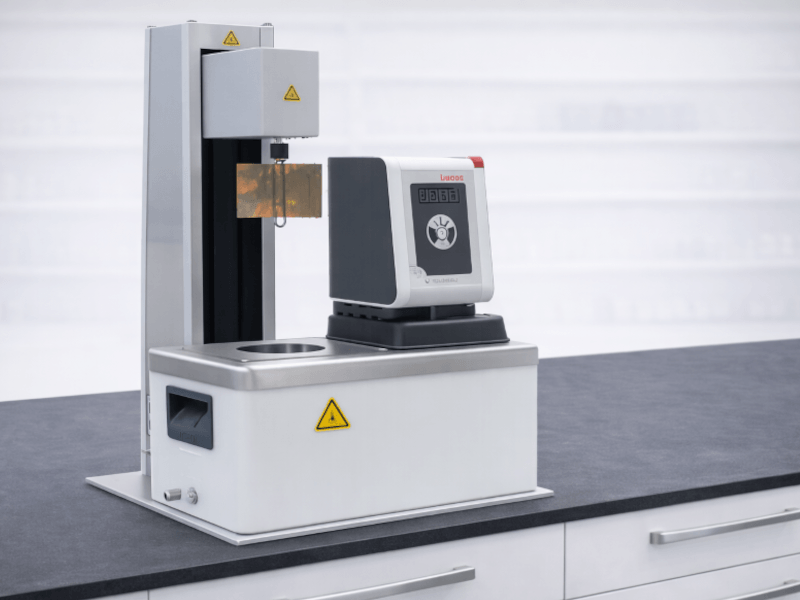
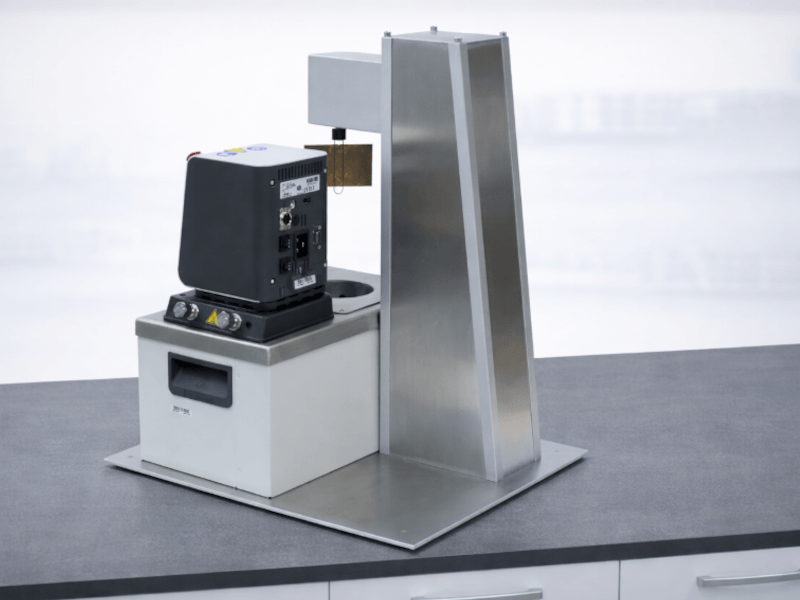
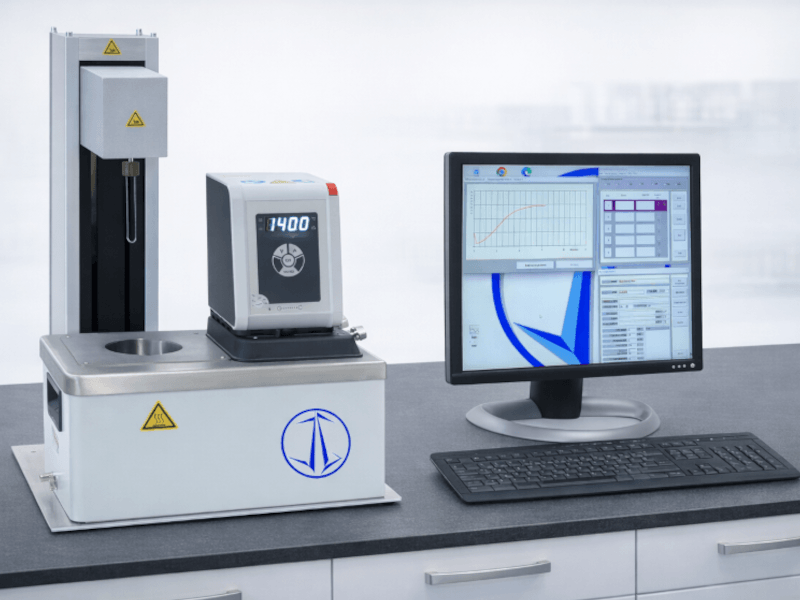
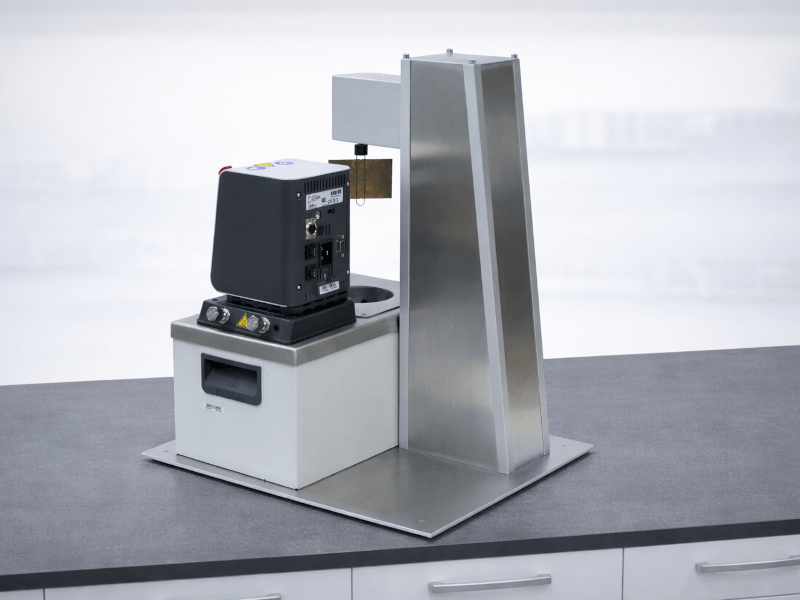
Application in the coating of wood-based materials
In the lamination of various materials, impregnated paper webs, fabrics, and similar materials are used across a very wide range. These coating materials are dried during wet impregnation.
During drying, the different resin components are brought into a so-called B-stage. This stage is necessary to ensure storage stability until further processing.
During further processing into boards, molded parts, strips, rolls, and similar products, the intermediate product is transformed from the “B” stage into the final “C” stage, meaning that an irreversible state of the resin component is achieved.
The intermediate material “impregnated films” is essentially evaluated based on the following characteristics:
- Basis weight
- Resin content (%)
- Volatile content (%)
- Flow values (%)
The additional properties are primarily evaluated on the finished product, for example:
- Strength
- Hardness
- Flexibility
- Crack resistance
- Abrasion resistance
- Surface integrity
- Gloss level
- Transparency, etc.
Until now, there have been major unknowns regarding the “degree of condensation,” “hardness development rate,” and the “curing characteristics” between the B-stage and C-stage. Only the film analysis device is capable of measuring and analyzing these characteristics, which depend on many influencing factors.
The main difficulties arise in duplex processing, i.e., when multiple layers are pressed together and differing characteristics occur between the individual layers. This can lead to non-closed (porous) surfaces, gaps within the system, and deviations in technical properties due to over- or under-curing.
Mr. Jörg Golombek, former Head of Research and Development at WERZALIT, developed a method to make these characteristics measurable in the range between the B- and C-stage, and to represent them through the automatic recording of the hardness profile as a curve in a hardness/time coordinate system.
Over 30 years of practical experience have generated a wealth of insights, both in the production of impregnation resins, additives, and impregnated papers, as well as in incoming goods inspection and further processing.
With consistent application of this method among resin manufacturers, impregnators, and processors, a significant reduction in production risks and costs can be achieved by lowering reject rates and ensuring consistent quality standards.
Video of the measurement
Here you can see the fully automated measurement process. The film analysis device determines the hardness profile and curing characteristics of reactive resins.
Through automatic data acquisition, users achieve maximum process reliability, reduce waste, and sustainably lower production costs.
Further applications of the film analysis device for “reactivity measurements”
Reactivity and curing characteristics of adhesive slurries, e.g., for the production of particle boards, molded particle wood parts, and plywood.
With the film analysis device, it is possible to analyze changes in the adhesive slurry before processing and, in particular, during curing under press conditions.
- What happens in the surface layer at press temperature?
- How fast is the reaction in the core layer (middle layer), where temperatures of only about 105 °C–120 °C (for laminated wood <100 °C) are reached?
- Which hardener achieves the longest pot life at maximum reactivity under press conditions?
Applications include:
- Production monitoring of adhesive slurries
- Incoming goods inspection of adhesives and hardeners
- Casting, laminating resins, or prepregs and reactive adhesive systems
- Pot life, storage stability, and curing behavior at temperatures up to 200 °C for all known resin systems
- Two-component coatings (solvent-based or waterborne), bake-cure coatings
- Simulation of forced drying of reactive coatings
- Inspection of coatings and hardeners during incoming goods control
If you are interested in the applications of the film analysis device described above, simply contact us and benefit from our extensive experience with the instrument.
On this page, you`ll find all the relevant accessories.